The Launch of IGU-GEOSUS's African Chapter
October 20, 2025
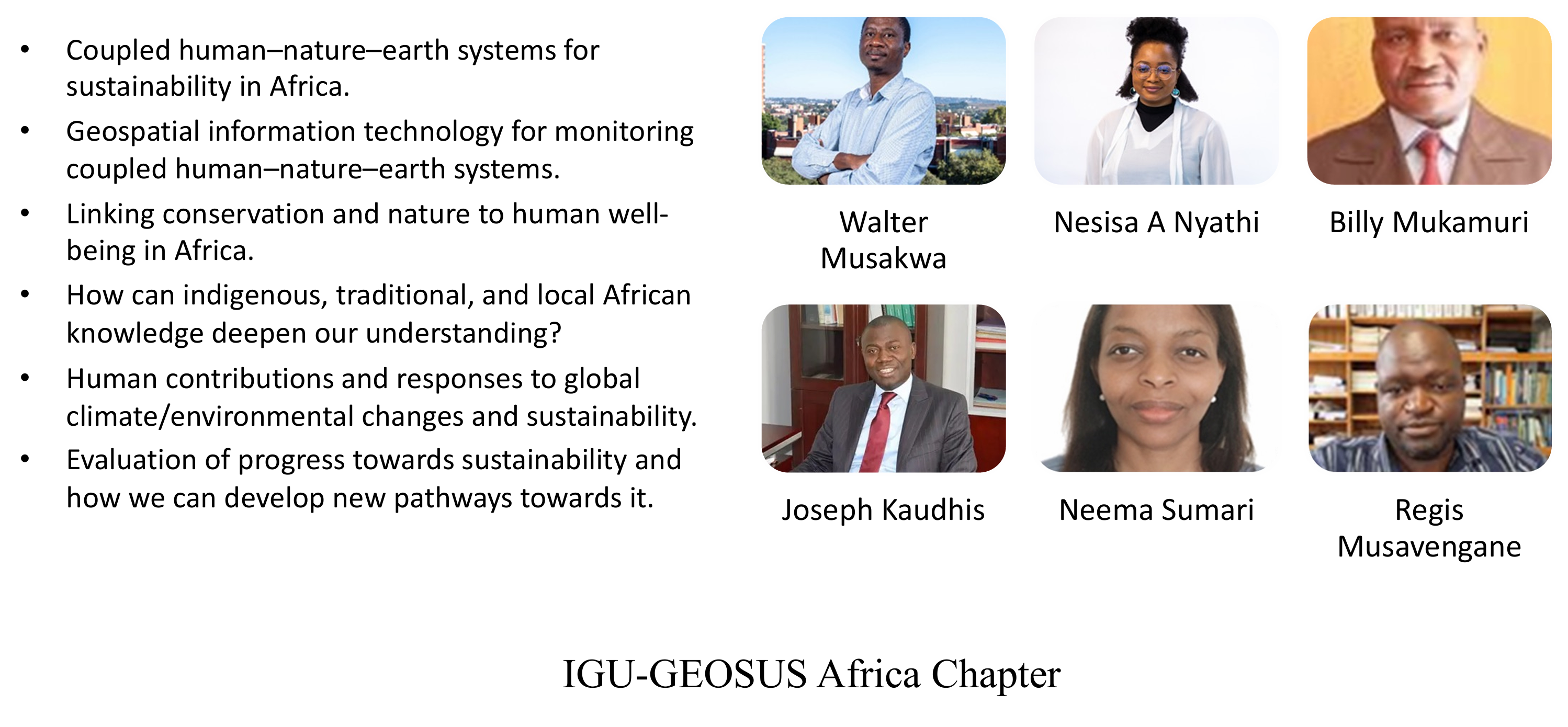
The IGU Commission on Geography and Sustainability's African Chapter was launched by Prof. Walter Musakwa (University of Johannesburg, South Africa) in October 2025. The mission of the African Chapter is to promote geography and sustainability in Africa. The main aim is to provide an African focus and interpretation of geography and sustainability. This is necessary due to the continent's history of colonization and the importance of indigenous, traditional and local knowledge systems.
The continent faces numerous challenges, including climate change, population growth, land and habitat degradation, poaching, and poverty. These challenges pose a significant threat to the sustainability, equity, and conservation of natural resources in Africa. Likewise, Africa is home to iconic species and biodiversity hotspots. The African Chapter seeks to conduct research and provide solutions to the challenges it faces, ensuring sustainability, conserving iconic species and biodiversity, and ensuring equity.
The African Chapter serves as the focal point for the development, coordination, and implementation of interdisciplinary research and education related to geography and sustainable development in Africa. The chapter aims to compile and share knowledge on geography and sustainability in Africa, thereby increasing the impact of research and exploring new development paths. This will contribute to achieving the global sustainable development goals by identifying context-specific approaches.
To this end, the commission aims to promote and facilitate the following six thematic areas:
- Fundamentals of coupled human–nature–earth systems for sustainability in Africa.
- Advances and inclusive platforms for geospatial information technology for monitoring coupled human–nature–earth systems.
- Linking conservation and nature to human well-being in Africa.
- How can indigenous, traditional, and local African knowledge deepen our understanding of complex earth systems and human dynamics at different scales, and provide solutions to some of the 'wicked' problems facing Africa?
- Human contributions and responses to global climate/environmental changes and sustainability.
- Evaluation of progress towards sustainability and how we can develop new pathways towards it.